
Proving compliance
How unified security findings map to CIS, SOC 2, ISO 27001 and PCI — and turn into auditor-ready, exportable evidence instead of a spreadsheet scramble.
One findings model
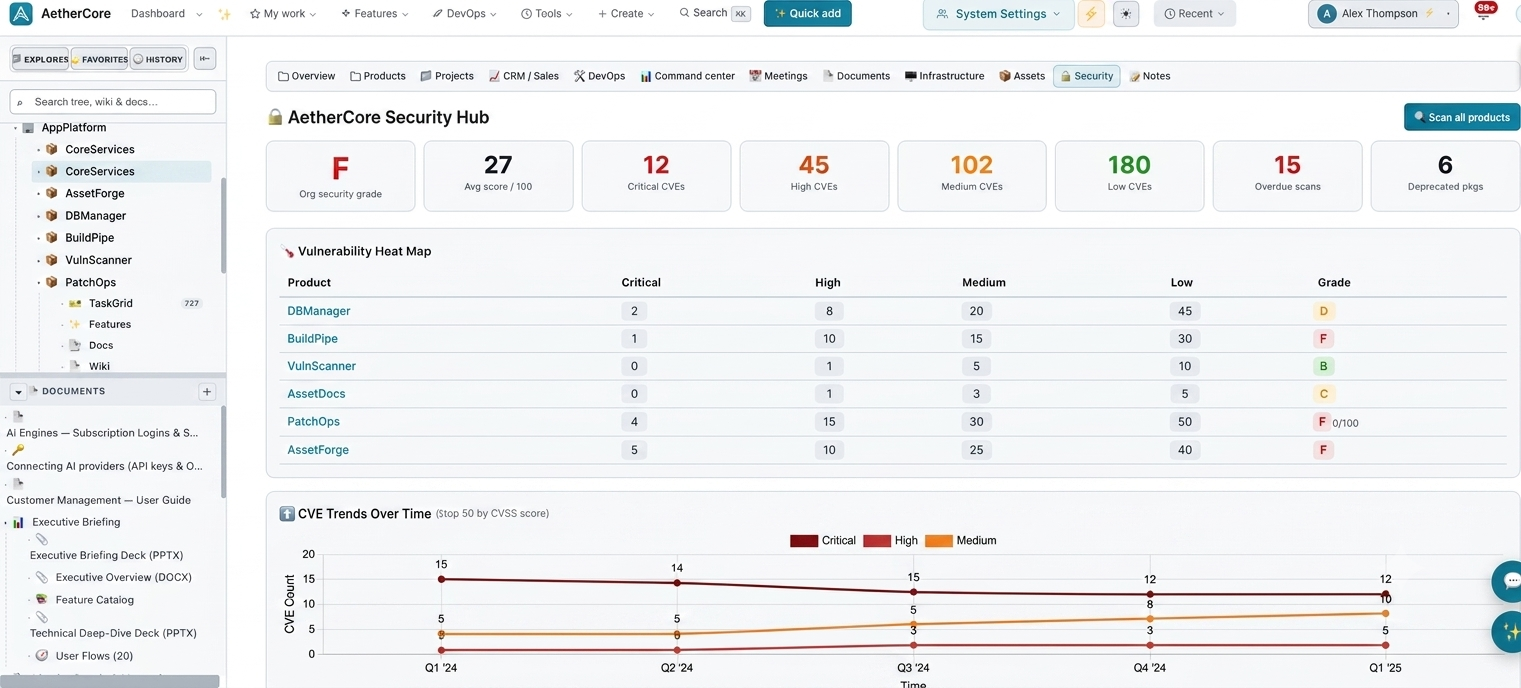
Heavy scanners (Trivy, Grype, gitleaks, checkov, kube-bench and more) run in a sidecar and feed a single unified findings store. Code, containers, infra, secrets and runtime all land in one place — no more reconciling five dashboards.
Risk graph & attack paths
Findings are folded into a resource graph — software, images, infra, cloud and credentials as nodes; runs-on, exposes and depends-on as edges. Resolve traverses the graph to find real attack paths and produces one graph-aware risk score per product.
Control mapping in code
The unified findings map onto CIS, SOC 2, ISO 27001 and PCI control families deterministically, in code — each control fails on matching open findings at or above its severity gate. Posture is the share of passing controls, graded A–F. No per-row hand-tagging.
Exportable evidence
Export a branded posture report per framework as a PDF — the artefact auditors actually ask for. A continuous sweep surfaces new critical/high findings, opens tickets and snapshots posture over time, so compliance is a living state, not a once-a-year panic.
Keep reading.
From meeting to scope
How a requirement conversation becomes structured tickets, a charter and a roadmap — without anyone writing it all up by hand afterwards.
Read guide →Supervised AI delivery
How AI agents scope, write and review code while engineers stay firmly in control — and why a single goal becomes a tree of tasks with an agent on each.
Read guide →Designing before you build
How Resolve designs the whole solution — architecture, data model and a clickable prototype — and gets your sign-off before a single line of code is written.
Read guide →From repo to production
How a commit travels through automated build, test, scan and deploy — and straight into live monitoring — on pipelines wired into the platform.
Read guide →Running it offline
How a whole project runs fully air-gapped on your own AI — no paid AI modules, no external APIs and no vendor lock-in.
Read guide →Walk through it on your own project.
We’ll scope your build in one meeting and show this lifecycle running against it, live.
Start a project → All guides