
From meeting to scope
How a requirement conversation becomes structured tickets, a charter and a roadmap — without anyone writing it all up by hand afterwards.
The problem with meeting notes
Most projects start with a good conversation and end with bad notes. Requirements live in someone’s head, scope drifts, and two weeks later nobody agrees what was promised. The write-up never quite happens.
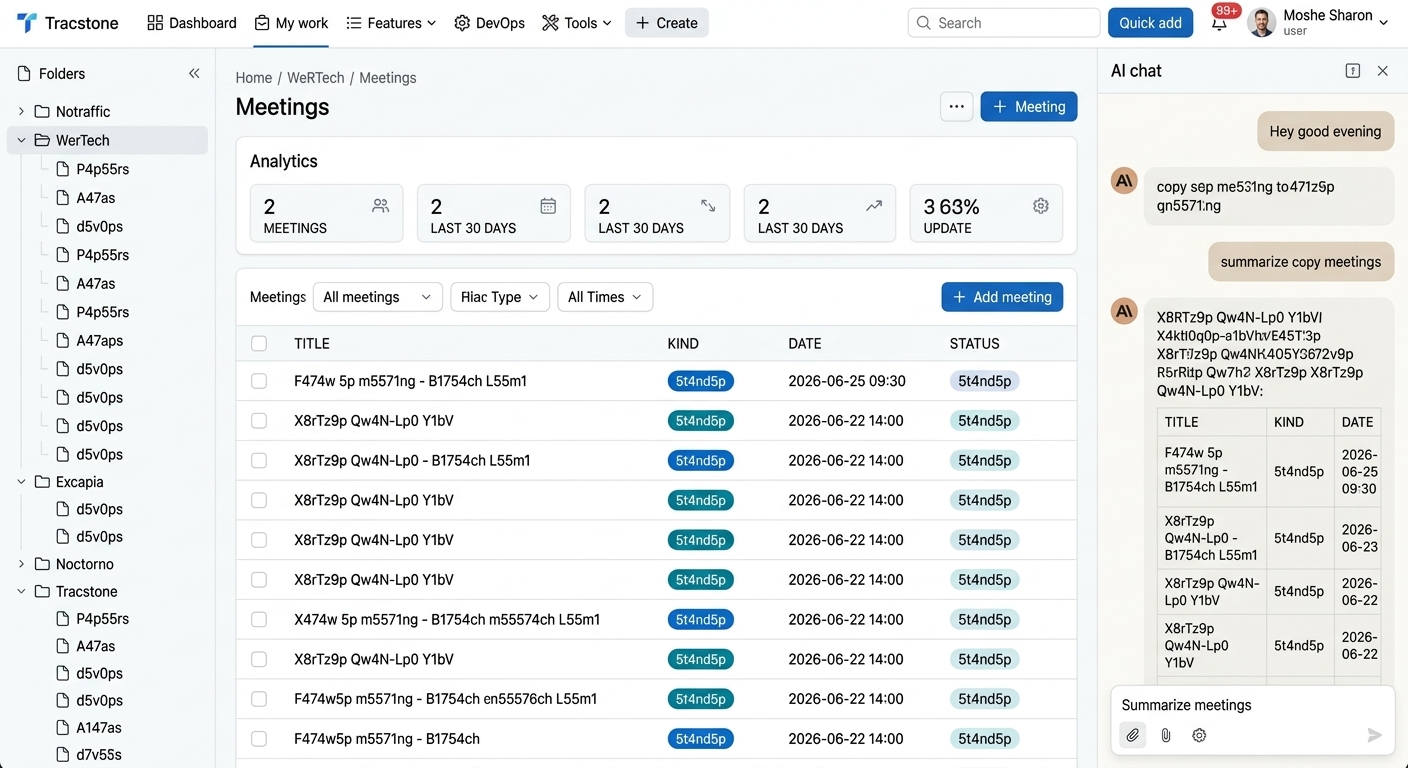
Resolve treats the meeting itself as the source of truth and turns it into structured, trackable work the moment it ends.
Capture the conversation
From a kickoff or requirement call, Resolve extracts the things that actually matter and files them:
- Goals and success criteria — what “done” looks like
- Actors, systems and integrations that have to be touched
- Constraints, assumptions and open risks
- Concrete action items, each becoming a ticket
Turn scope into a plan
Scope becomes a real project: a charter, RAG status, roadmap, RAID register, budget and time tracking. Pick Agile sprints or Waterfall phases, and let AI estimate and size the work so the timeline is grounded, not guessed.
Tickets that write themselves
Suggest-a-plan turns the headline goal into a tree of work — epics, features and tasks — each with an estimate and an owner. You review and adjust; you never start from a blank backlog.
Everything lands in your customer portal, so from day one you can see the plan, the roadmap and exactly where things stand.
Keep reading.
Supervised AI delivery
How AI agents scope, write and review code while engineers stay firmly in control — and why a single goal becomes a tree of tasks with an agent on each.
Read guide →Designing before you build
How Resolve designs the whole solution — architecture, data model and a clickable prototype — and gets your sign-off before a single line of code is written.
Read guide →From repo to production
How a commit travels through automated build, test, scan and deploy — and straight into live monitoring — on pipelines wired into the platform.
Read guide →Proving compliance
How unified security findings map to CIS, SOC 2, ISO 27001 and PCI — and turn into auditor-ready, exportable evidence instead of a spreadsheet scramble.
Read guide →Running it offline
How a whole project runs fully air-gapped on your own AI — no paid AI modules, no external APIs and no vendor lock-in.
Read guide →Walk through it on your own project.
We’ll scope your build in one meeting and show this lifecycle running against it, live.
Start a project → All guides